
Notifications of diphtheria have been increasing in Australia since October 2025 and on Monday 25 May the Chief Medical Officer declared diphtheria a Communicable Disease Incident of National Significance (CDINS). This means Australia is stepping up a nationally coordinated response to a growing outbreak. It allows governments and health services to work together more quickly to get vaccines, medicines, staff and support to the communities that need them most.
To date, 94% of cases have been reported among Aboriginal and Torres Strait Islander people and nearly all cases have occurred in residents of regional and remote locations. While most cases have occurred in Western Australia and the Northern Territory, all jurisdictions in Australia are on watch.
Preventing diphtheria through vaccination
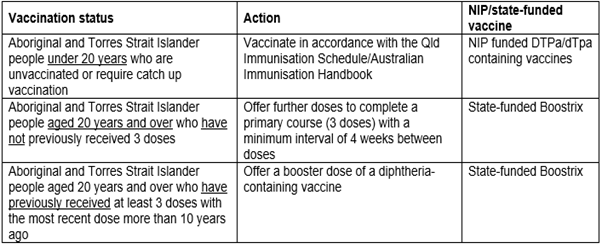
With an imminent threat of impacts from the current outbreak, the best method of preventing diphtheria is vaccination. Three doses of diphtheria-containing vaccine in early childhood followed by booster doses at 18 months, 4 years and Year 7 of school and intervals throughout adulthood, are needed to produce and maintain immunity. Missing doses can be provided according to the table below, noting that First Nations people aged 20 years and older in Queensland are now eligible for state funded dTpa vaccine (Boostrix).
To improve vaccination coverage, especially among Aboriginal and Torres Strait Islander people, it is recommended to:
- Check your vaccination overduenotices and recall children who require catch-up
- Audit vaccination status ofadult patients and recall for vaccination as indicated
- Opportunistically checkpatients are up to date with vaccination and provide dose/s as indicated
Table: Current Diphtheria-containing vaccination recommendations for Aboriginal and Torres Strait Islander people in QLD:
See the Australian Immunisation Handbook | Diphtheria for further information and recommendations for diphtheria vaccination in children, adolescents, pregnant people, and adults.
Diphtheria
Diphtheria is caused by toxin-producing strains of the germ Corynebacterium diphtheriae. Most Corynebacterium diphtheria germs are not toxin producing, and they can cause mild or asymptomatic skin or throat infections. However, toxin-producing germs can cause severe and life-threatening disease, especially in people who are unvaccinated or under vaccinated.
The germ is carried in the in human nose and airway and the germ is spread person to person through respiratory droplets and through contact with infected skin or contaminated surfaces.
Attached Clinician Alert
The attached alert circulated by the Communicable Diseases Branch on 19 May 2026 contains information on clinical presentation, testing and treatment, and infection prevention and control. Please share with clinicians and watch for further updates.
More information on diphtheria is available at:
https://www.health.qld.gov.au/disease-control/conditions/diphtheria
More information on the current diphtheria situation across Australia is available at:
https://www.cdc.gov.au/newsroom/news-and-articles/diphtheria-outbreak-update
https://www.cdc.gov.au/resources/collections/diphtheria-australia-epidemiological-updates


